Yes, Cairn is worth playing if you want a focused single-player game that rewards patience. It is not my answer for the next game you will play for six months. It is a relatively short, memorable break from games that expect to become a second job.
I am in my late 30s, I have gamed for a long time, and I have also done some bouldering. Cairn surprised me because it understands something many climbing games miss: progress is not always about moving faster. Sometimes the satisfying move is stopping, looking at the wall, shifting your weight, and choosing a better hold.
That makes it feel almost therapeutic—until you rush and turn a calm climb into an avoidable disaster.
The short version
- Play it if: You want a finite, atmospheric single-player game and enjoy deliberate physical problem-solving.
- Skip it if: You need constant action, hate failure caused by positioning, or want a long-term progression game.
- What makes it special: The wall is the puzzle. Route choice, balance, rest, and resource decisions matter more than memorizing a combo.
- Platforms: PC and PlayStation 5.
- My take: Slow down. Cairn gets better when you stop treating every hold like a quick-time event.
Why Cairn feels therapeutic
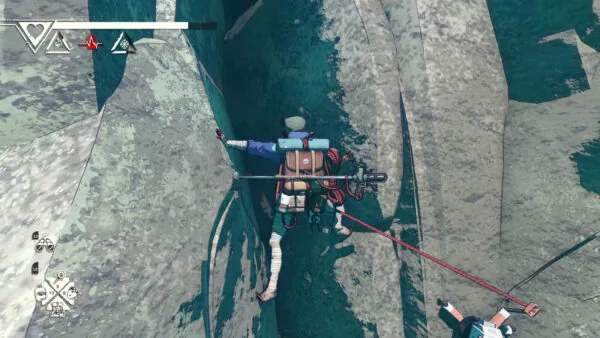
There is a rhythm to a good section of Cairn. Look upward. Find a line. Place one limb. Check whether Aava is stable. Move again. The game gives you enough control to feel responsible without asking you to puppeteer every joint.
For me, that rhythm became calming. It demands attention, but it is narrow attention. I was not clearing a map covered in icons, juggling daily challenges, or listening for the next battle-pass notification. I was trying to get one climber a few meters higher without making a stupid decision.
That focus is the appeal. Cairn can be tense, and later stretches absolutely push back, but the underlying activity encourages patience. When a route feels wrong, the answer often is not “try the same thing faster.” It is to pause, read the rock, and find a position that asks less of your body.
The climbing is more accurate than I expected
Cairn is not a perfect simulation of bouldering or mountaineering. No controller can reproduce how a hold feels, and the game necessarily simplifies movement. But as somebody who has bouldered, I recognized real ideas in the way it wants you to solve a wall.
Good climbing is not just upper-body strength. Foot placement matters. Balance matters. Keeping your center of gravity in a useful position matters. A small hold can work when the rest of the body is arranged well, while an apparently comfortable reach can leave you stretched, unstable, and burning energy.
Cairn captures enough of that logic to reward a climbing mindset. The Game Bakers says Aava can use tiny crimps and wedge her feet into cracks, while the player chooses the route and holds. In practice, the important achievement is not that every animation is technically perfect. It is that taking time to find a sensible sequence usually feels better than flailing upward.
The game also understands route reading. You can climb broadly where you choose, so the line that first catches your eye is not automatically the smart one. Looking from below, identifying rest points, and avoiding a position with no clean next move all feel relevant.
Slow is smooth, and smooth is surprisingly fun
Games train us to equate mastery with speed. Cairn often reverses that. A clean section can look uneventful: four careful placements, a pause, and a secure arrival. Yet it feels excellent because you know how easily one greedy reach could have wrecked it.
This is the advice I would give somebody starting the game: do not rush just because Aava can reach something. Find the right holds, keep several points of contact when possible, and notice when her posture is telling you that the next move will be expensive.
That does not mean the game is passive. The tension comes from committing to your own plan. You chose this route. You used these resources. You decided the next hold was worth reaching for. When it works, the satisfaction is unusually personal.
It is a break, not a forever game
Cairn is not a long-term gaming answer. It does not replace the multiplayer game your group returns to every Friday, and it is not an endless build-crafting hobby. That is a strength.
Sometimes I do not need another ecosystem. I need one good single-player game with a clear identity, a beginning, and a summit. Cairn offers a relatively short but worthwhile reset: enough time to learn its language, become attached to the climb, and leave before the central idea wears thin.
If you are sitting in front of a library full of 100-hour commitments and nothing sounds appealing, Cairn fits the gap surprisingly well. It asks for focus while you are playing, then lets you be done.
What might push you away
Cairn will not feel therapeutic to everybody. Deliberate controls can read as clumsy when you are trying to move quickly. A fall after careful progress hurts. Resource management adds survival pressure to what could otherwise have been a pure climbing puzzle.
The realism also has limits. Players with climbing experience will notice techniques the control system cannot express, and a body position that looks strong in real life may not always behave the way you expect in the simulation. I found the climbing logic convincing enough to enjoy, not flawless enough to use as instruction.
The game needs you to accept its pace. If the idea of studying a wall, making tiny adjustments, and occasionally backing out of a bad route sounds tedious, the atmosphere will not rescue it.
Who should play Cairn?
Play Cairn if you want a shorter single-player recommendation with atmosphere, mechanical purpose, and a finish line. It is especially easy to recommend to climbers, former climbers, and anyone who enjoys games where movement itself is the main puzzle.
Skip it if you need a forever game, fast combat, or effortless power fantasy. Aava is an expert climber, but the mountain still demands respect—and the whole experience works because the game gives you time to learn that.
For me, Cairn was a genuine change of pace. It was accurate enough to wake up old bouldering instincts, focused enough to quiet everything outside the climb, and short enough not to overstay its welcome. I reached the end satisfied, not ready to make it my next six-month hobby.
Still not sure?
Use the game recommender if you want another focused single-player game but Cairn's deliberate climbing does not sound right. If you already have a few short games in mind, paste them into the game randomizer and stop negotiating with your backlog.